
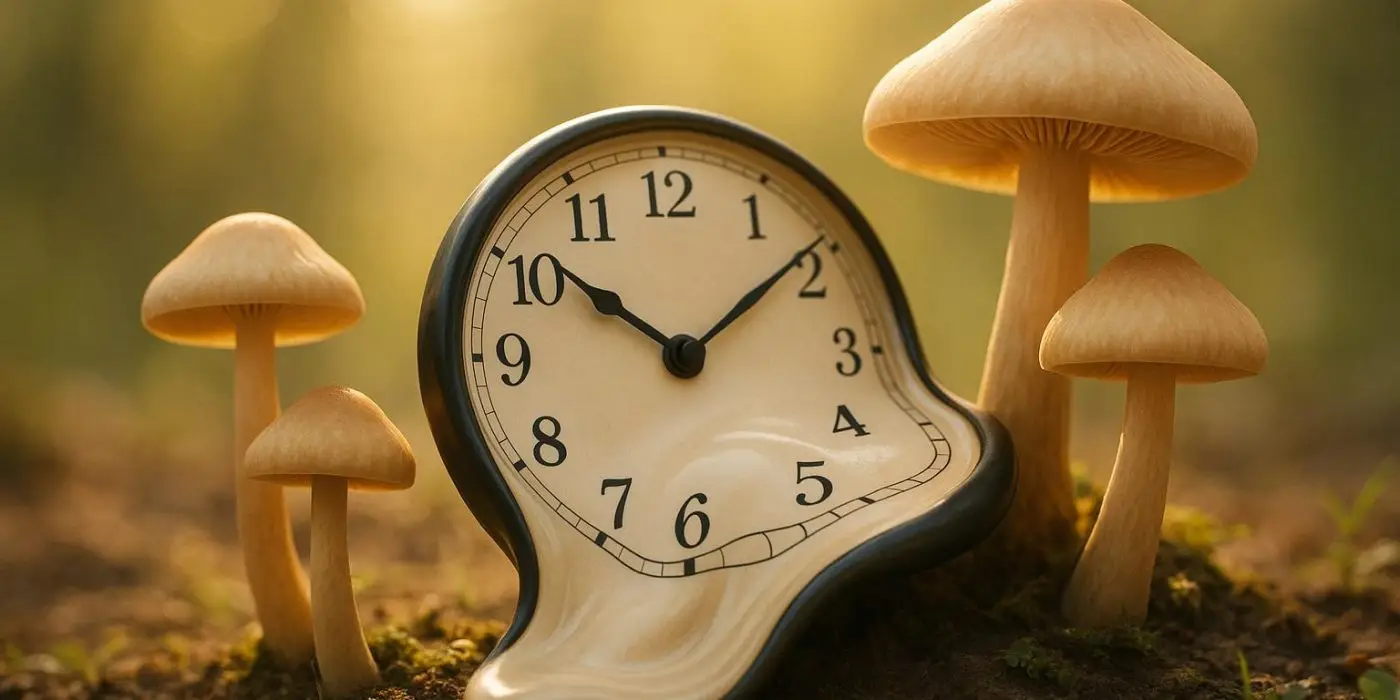
Psilocybin, the active compound in certain mushrooms, is known for its ability to alter how people perceive time. Users often report experiences like time slowing down, moments stretching endlessly, or even a sense of timelessness where past, present, and future seem to merge. These effects are tied to psilocybin’s interaction with serotonin 2A (5-HT2A) receptors in the brain, disrupting the brain’s internal clock and altering perception.
Key takeaways:
- Time distortion: Psilocybin users frequently experience slowed time, timelessness, or difficulty judging durations.
- Brain mechanisms: The serotonin system, especially 5-HT2A receptors, plays a central role in these effects. Brain areas like the prefrontal cortex and default mode network are also involved.
- Therapeutic potential: Time perception changes may help reduce anxiety, depression, and stress by enhancing present-moment focus and breaking rigid thought patterns.
- Research insights: Studies show dose-dependent effects, with higher doses causing greater time distortions and deeper altered states.
How Psilocybin Changes Time Perception
What Users Report About Time Changes
Psilocybin users often describe dramatic shifts in their perception of time. Many report feeling as though time has completely stopped. Moments may seem to stretch endlessly, while hours can feel like they pass in mere minutes. These experiences are often accompanied by a sense of detachment from oneself and the surrounding environment. Some users even describe a blending of past, present, and future, where time no longer feels linear. These effects tend to vary depending on the individual’s psychological state, setting the stage for scientific studies to explore these phenomena more objectively.
Research Studies on Time Perception
Research has provided some fascinating insights into how psilocybin alters time perception. A double-blind study by Wittmann et al. examined 12 healthy participants under three conditions: placebo, a medium dose (115 µg/kg), and a high dose (250 µg/kg) of psilocybin. Participants were asked to perform tasks designed to measure their sense of time, such as reproducing time intervals, synchronizing movements to beats, and tapping at a steady tempo.
The results showed that psilocybin significantly disrupted the ability to reproduce time intervals longer than 2.5 seconds and made it harder to synchronize to beats lasting more than 2 seconds. Additionally, participants’ preferred tapping speed slowed down. These findings aligned with users’ subjective accounts of time distortion. The impairments primarily affected longer time intervals, suggesting that psilocybin influences how the brain processes extended durations. Researchers also noted that these timing deficits were linked to changes in working memory and altered states of consciousness, emphasizing the role of the serotonin system in these effects.
How Dosage Affects Time Perception
The extent of time distortion caused by psilocybin appears to depend heavily on dosage. Higher doses tend to amplify these effects. In the Wittmann et al. study, participants who received a medium dose (115 µg/kg) showed noticeable difficulties with tasks involving longer time intervals, though their ability to handle shorter intervals remained relatively intact. At the higher dose (250 µg/kg), these impairments became much more pronounced across all tests.
This dose-dependent relationship has practical implications. For instance, lower doses may be preferable for those seeking milder perceptual changes, while higher doses are more likely to produce the profound time distortions often associated with mystical or transformative experiences.
Psilocybin desynchronizes the human brain
Brain Science Behind Time Distortion
Let’s dive into the brain mechanisms behind the strange phenomenon of time distortion.
How Serotonin Receptors Affect Time
Psilocybin primarily alters how we perceive time by targeting serotonin 2A (5-HT2A) receptors. When this receptor is activated, it disrupts the brain’s ability to track time accurately. Interestingly, when ketanserin – a 5-HT2A antagonist – is introduced, it blocks psilocybin’s effects on neural timing. This highlights the critical role of serotonin 2A receptors in shaping our sense of time.
Brain Areas That Process Time
Several brain regions collaborate to create our sense of time, and psilocybin significantly impacts these areas. For instance, the prefrontal cortex, responsible for encoding and integrating longer time spans, becomes disrupted, making it harder to judge durations lasting several seconds or more. Meanwhile, the basal ganglia handle millisecond-level timing, crucial for tasks like motor coordination, while the cerebellum ensures movements are timed with precision.
The insula plays a unique role by connecting bodily sensations with our perception of time. Then there’s the default mode network (DMN) – a group of brain regions tied to our sense of self, space, and time. Under psilocybin, the DMN shows desynchronization both within itself and with other networks. This disruption often correlates with the feeling of timelessness, where distinctions between past, present, and future blur together. Beyond these key regions, other neurotransmitter systems also influence how we perceive time.
Other Brain Chemicals Involved
While serotonin and the 5-HT2A receptor play a central role, other neurotransmitters also shape psilocybin’s effects on time perception. Dopamine helps process rapid sequences of time, while glutamate, acting through NMDA receptors, supports broader cortical functions that influence timing. The interaction between these neurotransmitters amplifies psilocybin’s unique impact on how we experience time.
sbb-itb-a39e8e6
Medical Benefits of Time Perception Changes
Psilocybin’s ability to alter our sense of time isn’t just a fascinating phenomenon – it’s showing real promise in medical and therapeutic contexts. Researchers are uncovering how these shifts in time perception can play a role in stress reduction, mental health treatment, and even spiritual healing.
Time Changes and Present-Moment Awareness
One of psilocybin’s standout effects is how it creates a feeling of timelessness. This state pulls individuals into the present moment, helping them let go of worries about the future or regrets about the past. Instead of being trapped in cycles of anxious thoughts or self-criticism, people can focus on their immediate emotional experiences.
On a neurological level, psilocybin reduces activity in the amygdala, the brain region tied to fear and negative emotions. This dampened reactivity contributes to a sense of calm and stress relief.
Mental Health Treatment Applications
By altering how we perceive time, psilocybin disrupts patterns of depressive and anxious thinking. It becomes harder to fixate on past failures or imagine worst-case future scenarios.
Many patients describe how time distortion during psilocybin sessions allows them to step back emotionally and see their trauma from a new angle. This emotional distance often leads to breakthroughs in therapy, helping them process difficult experiences in a healthier way. In fact, studies show that feelings of timelessness during these sessions are linked to reduced depression and greater psychological flexibility.
Psilocybin in Spiritual Healing
Psilocybin’s effects go beyond clinical settings. Organizations like PsiloVibe Church use psilocybin in spiritual ceremonies designed to promote self-reflection and emotional healing. These experiences often involve stepping outside the usual boundaries of time, allowing participants to gain deep personal insights.
During these ceremonies, the lines between past, present, and future fade, giving individuals the space to confront emotional wounds, challenge limiting beliefs, and cultivate mindfulness. PsiloVibe Church offers psilocybin-based rituals aimed at fostering spiritual growth and long-term healing.
Conclusion: What We Know About Psilocybin and Time
Recent research has shed light on how psilocybin affects our perception of time. What once relied on anecdotal evidence has now been bolstered by scientific studies, offering new insights into consciousness, brain function, and therapeutic possibilities.
Key Scientific Findings
Studies consistently show that psilocybin alters time perception, often creating a sensation of time slowing down or even dissolving altogether, where the boundaries between past, present, and future blur into one. In controlled lab settings, researchers found that psilocybin disrupts the ability to accurately measure or synchronize time intervals longer than 2–3 seconds.
These effects are linked to the activation of serotonin 5-HT2A receptors. For instance, a double-blind study involving 12 healthy participants revealed that medium to high doses of psilocybin impaired their timing abilities, with higher doses causing more pronounced distortions. This underscores the dose-dependent nature of psilocybin’s impact on time perception.
Benefits for Treatment and Spiritual Growth
These findings have practical implications for both therapy and spiritual practices. Altered time perception under psilocybin can heighten present-moment awareness and interrupt harmful thought patterns, making it particularly promising for treating conditions like depression and anxiety.
On the spiritual front, organizations such as PsiloVibe Church are exploring these effects through psilocybin-based rituals. By offering sacraments like capsules, chocolates, and teas, they aim to harness the sense of timelessness and unity that psilocybin can evoke. This approach highlights how these experiences can promote emotional healing and spiritual growth.
Additionally, the loosening of rigid time constraints during a psilocybin experience seems to foster mental flexibility and emotional breakthroughs that often persist well beyond the immediate effects.
What Research Comes Next
While current studies provide valuable insights, they also highlight the need for further research. Many experiments have relied on small participant groups and controlled environments, which might not fully capture the range of experiences people have in everyday settings. Larger, more diverse studies could help clarify how time perception changes contribute to long-term therapeutic outcomes.
Future directions should include combining neuroimaging techniques with detailed assessments of time perception in both healthy individuals and those with psychiatric conditions. Comparing psilocybin’s impact on time with similar distortions seen in disorders like schizophrenia could uncover shared mechanisms and inspire new treatment strategies.
Collaboration between academic researchers and groups like PsiloVibe Church could also provide meaningful real-world data on how altered time perception influences both spiritual and therapeutic journeys. As psilocybin research grows in the United States, understanding its effects on time perception will be a key step toward creating evidence-based therapies and shaping policies around psychedelic treatments. This ongoing exploration bridges the gap between science and spirituality, offering a deeper look into psilocybin’s transformative effects.
FAQs
How does psilocybin affect the brain to change our perception of time?
Psilocybin influences how we perceive time by engaging with serotonin 2A receptors in the brain. This connection boosts activity in areas like the prefrontal cortex and the default mode network – regions that play key roles in processing time and self-awareness.
Research shows that this can result in experiences where time feels stretched, compressed, or even completely out of sequence, giving rise to a sensation of timelessness. These unique effects help explain why psilocybin is often linked to deep spiritual and introspective journeys.
How can psilocybin-induced time distortion benefit mental health, particularly for conditions like anxiety and depression?
Psilocybin’s effect on time perception allows individuals to break free from their usual mental patterns, offering a new way to view their thoughts and emotions. This shift often encourages emotional release, helping to ease the burden of past traumas while nurturing feelings of forgiveness and self-compassion.
For those dealing with anxiety or depression, this altered experience of time can open the door to mindfulness and deeper self-reflection. Many who undergo these experiences describe a renewed sense of connection – with themselves and with others – that feels profoundly meaningful.
How does psilocybin dosage affect changes in time perception, and what does this mean for recreational and therapeutic use?
The way psilocybin affects time perception largely depends on the amount consumed. With smaller doses, people often notice slight shifts – time might feel slower, more fluid, or just a bit "off." But as the dosage increases, the experience can become much more intense. Time might seem to stop altogether, speed up uncontrollably, or lose its usual sense of order.
These shifts in time perception carry meaningful implications. For those using psilocybin recreationally, understanding the relationship between dosage and effects is crucial for ensuring a safe and mindful experience. In therapeutic settings, such as trauma healing or mindfulness practices, these time distortions could help individuals process emotions or explore new ways of thinking. No matter the context, psilocybin should always be approached with care, thoughtful preparation, and respect for its powerful effects.